I have Bandelier National Monument all to myself. It’s late in the evening. The visitor’s center has closed already, and the parking lot is almost empty. A storm is gathering in the sky above the end of the valley. It broods and threatens and sends gusts of warm wind ahead of itself.
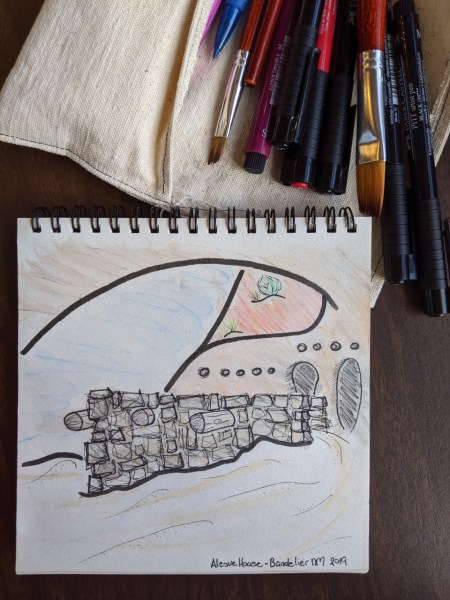
I’m sitting in the middle of an ancient pueblo. The remains of crumbling volcanic rock walls circle around me. They stand only a few feet high now, but they still mark out the foundation of the pueblo clearly. Five consecutive rings of rooms circle a large courtyard, where I’m now sitting.
Once, the rooms were stacked up to five stories high, housing a bustling community of 100 people. The rooms have no doorways. They were accessed by ladders running down from an opening in the ceiling to keep out pests and cold. I imagine what that would be like. Dark rooms connected by ladders and skylights. To get from a room on the top floor to a room on the bottom you would have to know which rooms connected in a linked chain of ladders. At first that sounds disorienting and impractical. Then I remember that the residents of this pueblo would have lived here for most of their lives. Instead, I imagine knowing a place so well that I could effortlessly navigate its simple maze. That sounds comforting and familiar. And in that moment, I connect with a life which is long gone and very different from my own.

Imagination is incredibly powerful. When a medieval knight named Ignatius was wounded in battle, he spent months convalescing in a family castle with nothing to read but the Bible and biographies of saints. As he lay in bed, Ignatius let his mind drift in and out of daydreams of dinner with Jesus and debates with the disciples. He imagined what it would be like to walk hot, dusty roads following a country carpenter. He imagined being present at the crucifixion and the joy of the first Easter morning. This mystic practice of Sacred Imagination lead to a powerful conversion for Ignatius and he went on to establish the Jesuit order and become a saint in the Catholic church.
I’ve come out to Bandelier National Monument to practice Sacred Imagination like St. Ignatius once did. It’s not hard. The power of the past is pervasive in this valley. Rock walls riddled with holes like swiss cheese rise to the sky. The air glimmers off the leaves of the trees growing by the riverbed. It’s quiet. Occasionally an insect or bird calls out from the bushes.
This has been the ambient noise of the valley for centuries. It would have sounded this way to the original inhabitants over 700 years ago. I feel the warm air on my skin and smell the scent of dried plants. I imagine that the walls of the pueblo are reconstructed around me. I can hear the bustle of a small community getting ready for the nightly thunderstorm. Children are called inside as dogs chase domestic turkeys around the courtyard. Painted jars of ground corn and dried beans are tucked under cover. Ladders are pulled up for the night and the fires are stoked as families gather inside. Thunder rolls over the canyon walls. Rain follows it, giving the fields enough water to survive another day in the desert.
I’m surprised when my sacred practice sends a shiver down my spine. I suddenly remember how isolated I am. My goal was to come out when no one else would be around. But I now realize that while I’m alone, I’m also surrounded by ghosts.
Steeling my courage, I move further up the valley. High up the porous rock cliffs are alcoves used for storage. A sturdy wooden ladder allows modern visitors to climb into one. I instantly notice the difference as soon as I crawl in. The rock walls keep the air about 10 degrees cooler and block out the noise from the valley below. Some of these alcoves have grooves in the ceiling and floor, presumably to anchor a loom. In this one the walls are still black from smoke. The arched entryway looks out over the valley to the remains of the pueblo below. If I had chores to do, I would only do them here.
I imagine walking away from the pueblo, crowded with people I’ve known for my whole life, people I can’t stand for another second. I follow a path which starts in the tall grass and then leads straight up the rock cliff. My feet confidently fit into the grooves worn in the rock and I feel the sun beating down on my shoulders. Shouts echo up from the village and follow me as I go. I’m hot and grumpy and sick of everyone. But as soon as I enter the room carved into the cliff, all that fades away. It’s cool and quiet, and from up here the pueblo looks picturesque. I have peace at last, and a much-needed afternoon to myself.

Again, this imagined scene sends chills down my spine. I’m sitting in the same spot someone once sat centuries ago. I can feel their presence. My experience with mystic Catholic practices is giving me more than I bargained for. I feel nervous and on edge, like hundreds of unseen eyes are watching me from the growing shadows. The native people of today refuse to enter abandoned pueblos, and I’m beginning to see why. I try to tell myself that it’s only my imagination, but of course that doesn’t help. Because my imagination now contains an entire reconstructed village and a discontented soul seeking solitude in a cave. My imagination is haunting me.
It’s time to leave. I take a deep breath and skootch to the edge of the alcove. But if I’m going to manage the half-mile walk out of the valley at anything less than a panicked run, I’m going to have to make peace with the ghosts.
I imagine that I’m dead and gone and an inquisitive visitor is walking around my long-abandoned home. I’m not mad at them. I imagine watching that visitor walk where I walked, touch what I touched and feel what I feel. It makes me happy to see them treating my home as sacred.
With that, the ghosts are on my side. I look out over the pueblo one last time, its circular walls making rings in the long grass. No one has lived there in ages. But it’s still sacred. And still worth protecting. Bandelier National Monument protects a valley riddled with history. Where visitors can come and practice the sacred art of imagining themselves into someone else’s world. That act can be simple or mystical, but it is always sacred.
I climb down the rock wall and walk out of the valley. Back in my campsite, night falls and I sink into my hammock. The brewing storm turns into 180 degrees of lightning crackling on the horizon, but never touches me. One campsite over, a family settles in for the night. The children scream and chase each other through the darkness. Campfire smoke tickles my nose and thunder grumbles in the air. The past and present mingle in familiar smells and sounds.
I close my eyes and imagine.

 Kesia Lee
Amazing. I love that you make friends with the ghosts.
LikeLike