Greening – When the trees start to bud, and the hills are tinted with green right before spring arrives. A much looked for sign of spring in places with long, grey winters.
I did it! I moved to Alaska! It is still light at 11:00 at night, new snow fell on the ridge above town last week, and it feels like I stepped into a time machine back to February. When I moved into the Forest Service bunkhouse, none of the trees had leaves. For the second time this year, I get to eagerly watch for signs of new life and cheer on every green bud and tender sprout.
Similarly, I’m seeing signs of new life after COVID. The bare trees were as much of a shock to my system as the bare faces I saw in the grocery store. But with every new leaf and lifted restriction, I can see signs of summer around the corner and dream of leaving my masks in a drawer for good.
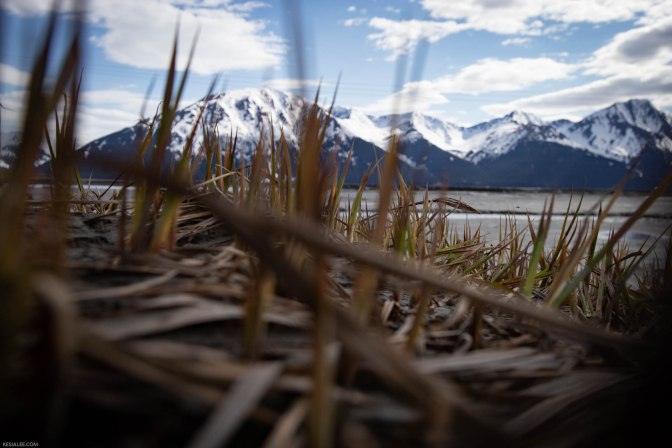
Drainage – Large valleys carved into the sides of mountains by a flowing river. Often used when describing landscapes: “Just past that drainage on the right”. Or for exploring: “There’s some great trails up in that drainage which lead to the ridge”.
The land here goes straight up from sea level to mountain peak. Foothills are for the lower 48. Instead of pointing out ranges at a distance, or a single noticeable peak, I’m learning the language of living in the mountains. Locals know the name of every ridge, valley, pass, and drainage. Specificity is important, especially for folks who make their living on the slopes year-round. There are descriptive names like 20 Mile Valley (I assume it is 20 miles long, but I haven’t checked), historical names like Portage Glacier (it was once used to “portage”, or cross, over the mountains), fantastical names like Fishes Breath (what does that even mean), and nonsensical names like Penguin Ridge (if there are penguins there, they are very far from home). Eventually, I will know where all of those are.

Kerf – The gap in a piece of wood made by a saw blade. The kerf expands and shrinks depending on the strain of the wood. A good sawyer knows to keep an eye on the kerf while sawing.
Week two of training was chainsaw class, and wow was that a trip. Within 24 hours I went from starting a chainsaw for the first time to cutting down a dead spruce tree. Normally, I don’t like learning that quickly. It stresses me out and throughout the week I could feel the tension as a constant strain in my body.
Ironically, tension was also a key point in the some-dozen trees I cut down that week. Learning to see the tension and predict its outcome was crucial. My instructor reminded me constantly to watch the kerf of the tree as I cut. If I cut too far in, the tension of the tree would cause the trunk to settle backwards, closing the kerf and pinching my sawblade inside of the still upright tree. However, if the kerf started widening, it was a sign that the tree was leaning over and about to fall – meaning it was time for me to get out of there.
I struggled at fist to keep my eye on the kerf amongst the million other things I had to keep track of. And even when I was looking, it was hard to notice the tiny differences. The tension I felt about detecting the tension of the trees would have prompted me to burst into tears in earlier years. However, with practice, I grew comfortable with stress and tension and unpredictability. Instead of fearing it in myself or a spruce tree, I accepted it as a state of being and a useful predictor of danger.
Finally, on the last day, I figured it out. My heart thumped in my chest as I noticed the telltale signs that my tree was about to fall. I stepped back confidently and smoothly as the trunk fell out of the sky and crashed down in exactly the path I had intended. My instructor yelled “You’re a logger!” and later that week I received my “A” Level Sawyer certificate.
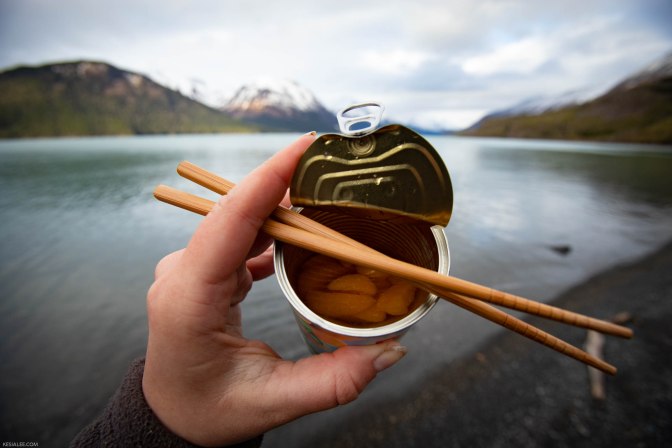
Step and Run – Sections of trail which are made of long boards (typically 2 or 3) that run parallel to the path. These are used to elevate a trail over boggy land but are uncomfortable to hike because over time they become slippery and uneven. Trail builders have realized that these are not effective and are now taking them out to be replaced with other methods.
Finally, finally, after weeks of training, I got out in the field and did the job I was hired to do. Not that I know how to do that either, to be honest.
If you (like many people) thought that trails just sprang into existence, think again! We have a team of nine expressly dedicated to maintaining the 15 trails in our district. Five of them will work on the same three miles all summer. I and two others will hike every trail as the snow melts, cleaning drains, cutting branches, and installing primitive toilets. Every new activity is patiently explained to me by my seasoned coworkers before I’m sent off into the woods to face the ravages of brown bears and weekend day hikers. Best Job Ever.
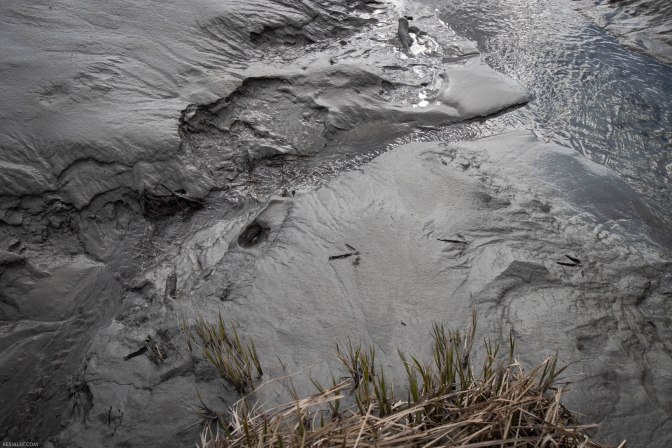
Skookum – A term from Chinook Jargon (a pidgin trade language of the Pacific Northwest) which means strong, brave, or good at. Occasionally seen in place names across the Pacific Northwest, like Skookum Glacier, or used as a complement of skill, “You’re skookum at that”.
After a year of only seeing the same 6 people, I was surprised by how natural it felt to move across the continent and live with complete strangers. I stress about it every time, but it’s so much fun to hear everyone’s ridiculous life stories and to tell them mine. I was worried that I’d be rusty, but it turns out I’m skookum at trying new things.


 Kesia Lee
Love it! Keep up the excellent content. Can’t wait to read your next blog.
LikeLike
Um, you failed to mention what that burned our vehicle is sitting there as click bait? Surely, you have a good word for that, too?
LikeLike
Nice pics and blog. We met you at Byron glacier trailhead and you gave us a clinic on how to take panos. Improved our skills. You are probably back home by now. How are you coping with atmospheric river?
rakesh and paige
PS; we drove from Sacramento to Anchorage via okanagan area. Quite an adventure
LikeLike