It’s the strangest sensation- falling in love with Cuba. You feel like Alice in Wonderland, falling through the looking glass and staring from the other side at a world which was once so familiar but is now all distorted and wobbly. It starts with propaganda on the street corner and lectures in your classes. Then you start to hear stories and learn new facts and then one day you find yourself staring at the cover of Fidel Castro’s “La Historia Me Absolverá” and you realize you almost believe it.
And then suddenly, unthinkably, Fidel is dead. And you find yourself defending him on the world stage.
And there are some things that I wish the world stage knew before it jumped to  conclusions. There are some facts I wish CNN had included instead of just saying “Fidel Castro, former leader of Cuba, dies. He was 90.” There are some stories I wish someone had told Donald Trump before he tweeted “Fidel Castro is dead!” like an unrestrained 12 year-old.
I wish people knew about the first class-doctors which Cuba ships off around the world to dispense medical aid. I wish people knew about the museums and concerts and national dance productions which any Cuban resident can afford because art should be for the people. I wish people knew about the friendship between Fidel and Nelson Mandela.
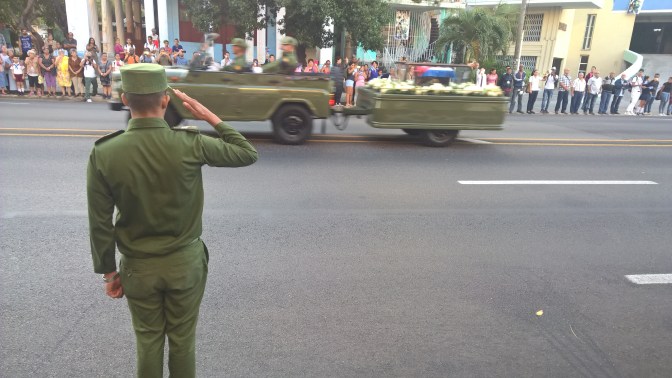
Fidel Castro is dead and I am in Havana watching an entire generation mourn and there is just so much which I wish the outside world knew.
For instance: There is a stretch of sidewalk on 23rd which is always filled with a line, three people deep and half a block long. This is the line to Copelia, where the citizens of Cuba can be treated to ridiculously cheap ice cream supplied by the government because Fidel believed that the residents of a tropical country should be able to afford ice cream no matter what.
Then there’s the matter of the toy train. The first time I saw it I was deeply confused. Its bright red, painted wooden trolley cars pulled by a tractor look like something which should be going ‘round and ‘round as a ride at a children’s fair, not up and down the Malecon in Havana, Cuba. I couldn’t figure out why it was there so I took the question to my five other American student roommates. We had to agree that it seemed to be a more or less legitimate form of transportation.
“But the thing I don’t understand,” someone said, “Is how it started. I mean can you just picture Fidel sitting around and being like ‘The revolution needs more forms of transportation. I know, toy train!’”
We all laughed, but the thing was that we could see exactly that.

And Fidel’s flights of fancy extend into more serious matters beyond toy trains and almost free ice cream. My first week in Cuba I visited Las Terazzas, a popular eco-tourism location about an hour outside of Havana. It was hard to believe that the land of lush hills, tall palm trees and flowing rivers which I saw had been a desolate wasteland devoid of vegetation just 50 years ago.
When Fidel visited Las Terazzas in the 60s he was appalled by the conditions he found. After more than a century of abuse at the hands of colonial plantation owners, the land was dead and the people were living in a state below impoverishment. Less than two months later, squadrons from Fidel’s army had arrived with millions of tree and plant starters. It was a reforestation project of massive proportions and would require huge commitments of time and money. The villagers living there at the time were told that they could stay or leave as they wished, but that if they chose to remain they would be committing to an ongoing ecological experiment.
It was awe inspiring to see the success of that experiment. Today the surrounding jungle looks just as if it had always been there and the area is filled with tourists coming to see  the miraculous recovery and enjoy the tropical paradise which is Las Terazzas.
When I left Bellingham, preparations were underway to clear cut the town’s favorite hiking spot which leads up a mountain to an overlook where you can see all of the Puget Sound. There was a long drawn out battle for the whole time I was at school as the locals attempted to wrestle control of the land away from the logging companies. But in the end they simply weren’t able to raise the 5 million dollars needed.
There are, of course, many sides to the issue, and many points for and against Fidel’s approach. But undeniably the land is better off for it, and the people too. I know it might be too much to hope, but maybe capitalism could take a page from Fidel’s book and learn that sometimes the environment is worth protecting simply for the sake of protecting it.
History will probably never absolve Fidel, not American history at least. And I’m not asking for absolution. I’m just asking that you take a moment to step into Cuba as I have seen it. It’s complicated and messy and sometimes overwhelmingly confusing, but it shouldn’t be written off as an oppressed nation under a despot leader.
There’s one story which I learned a few months after getting here and for whatever reason it always makes me smile when I think of it.
Fidel was giving a huge speech after the success of the revolution when he suddenly paused and turned to his skinny friend and fellow revolutionary, Camilo Cienfuegos, standing behind him with a giant beard and gold miner’s hat. Fidel said “Voy bien, Camilo?” Am I doing ok, Camilo? Camilo grinned at Fidel and said “Vas bien, Fidel” Yes, you’re doing just fine.
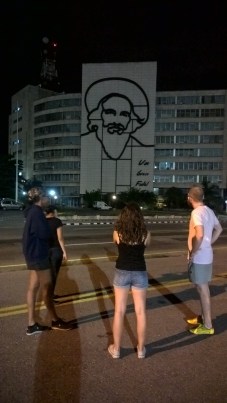
It’s not for me to judge another country’s revolution. But it is for me to whole heartedly say, today
“Hasta la victoria siempre, Comandante.”

 Kesia Lee
I hear your heartbeat on thus one. Sing your song!
LikeLike